My top 5 sights in Koblenz at a glance
Here you will find a brief overview of my top 5 sights that you should not miss.
Schängel Fountain
German Corner
Ehrenbreitstein Fortress
Prussian Government Building
Stolzenfels Castle
1. four towers
While strolling through Koblenz's pedestrian zone, you will come across four particularly beautiful houses - the so-called Four Towers- at a crossroads of the Old Town streets. These historic buildings were built in 1608 and are notable for their ornate oriel towers - hence their name.
After their destruction in 1688 and 1944, they were each rebuilt and their bay windows renovated. Each of the four towers tells its own story, which you can discover by taking a closer look at the houses.
For example, the Zu St. Petrus house housed a pharmacy from 1730 until the 2000s. At the Hauptwache, symbols such as guns and flags remind us of the soldiers who worked here as a kind of police force until 1848.
Today, the Four Towers are listed and are a very special sight in Koblenz - and a picturesque photo motif to boot.
Address: Altengraben 48 (Google Maps)
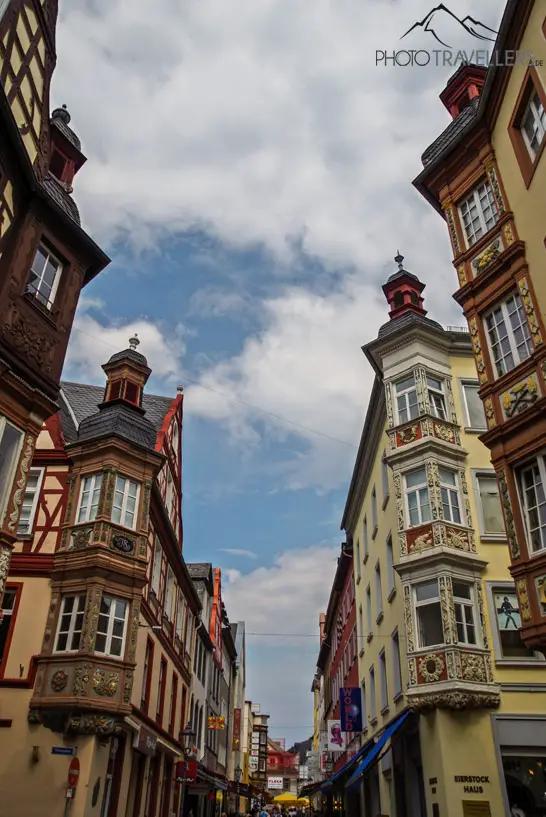 You can discover a lot on the colourful facades of the Four Towers
2nd Liebfrauen Church
Close by is the imposing Liebfrauenkirche, whose two onion domes, together with the other two Romanesque churches, St. Kastor and St. Florin, dominate the cityscape.
As early as the 5th century, the Franks established a Christian place of worship in a Roman predecessor building, which was to be the main parish church of Koblenz from the late Middle Ages until the French Revolution.
Over the centuries, the late Romanesque church was rebuilt several times, and after the air raid on Koblenz in 1944, it was rebuilt again, so that you can see a wide range of different architectural styles here.
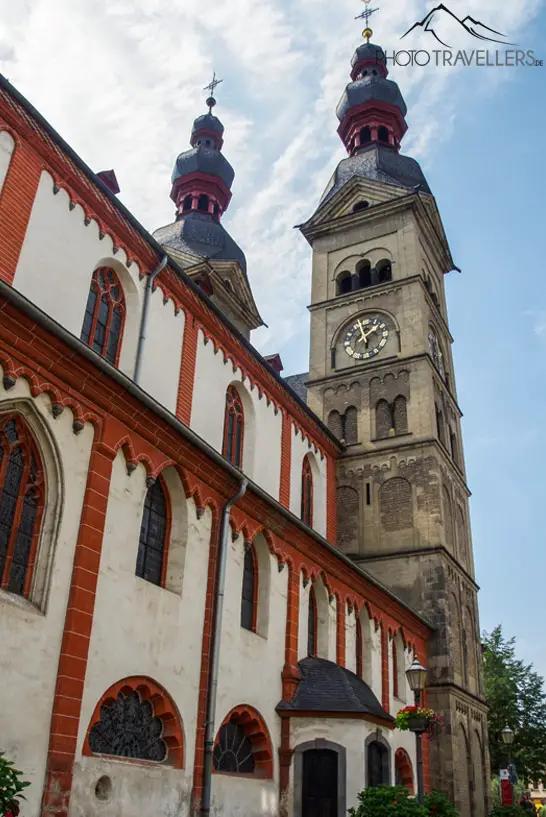 The unusual architecture of the Liebfrauenkirche does not escape the untrained eye.
A look inside is also worthwhile: here you can admire, among other things, the late Gothic star vault and important pieces of furniture such as the St. Nicholas altar from the period between the 15th and 18th centuries. The church is definitely a great sight to see.
Address: An der Liebfrauenkirche 16 (Google Maps).
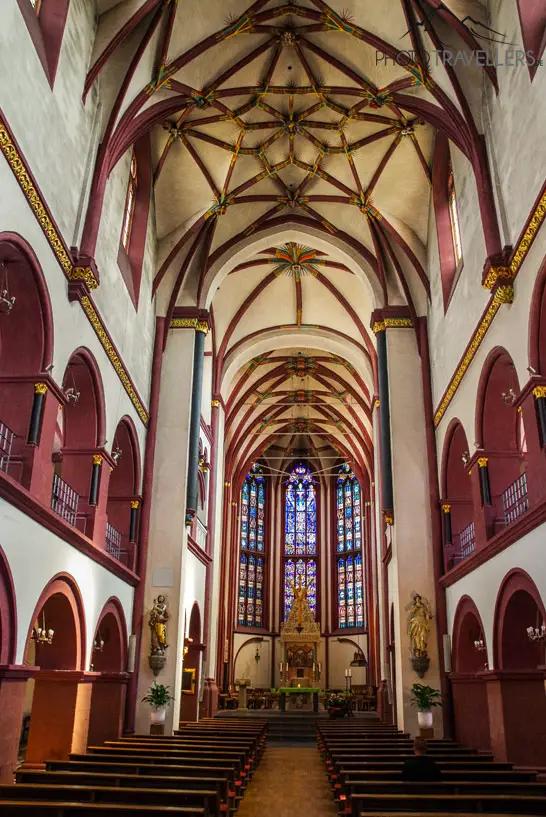 The interior is particularly impressive with its star-shaped vault.
3rd Schängel Fountain
The Schängelbrunnen is a landmark of the city and has stood in the town hall courtyard since 1941 - surrounded by the beautiful Renaissance and Baroque buildings of the former Jesuit College. It is dedicated to the Koblenz dialect poet Josef Cornelius, the author of the Schängellied - the anthem of the people of Koblenz.
The term "Schängel" dates back to the time when the city belonged to France for 20 years (1794-1813) and refers to the German-French boys with the common name "Jean", which corresponds to the German "Hans" or "Johann". In the Koblenz dialect, it first became "Schang" and finally "Schängel", a belittling form of "Schang".
To this day, native Koblenzers may call themselves "Schängel". The bronze figure on the fountain symbolises the quick-wittedness and Rhenish way of life of the people of Koblenz.
But beware: every few minutes, the little Schängel spits a jet of water several metres wide at passers-by, which is a pleasant way to cool down in summer, not only for children, but may be a little too cold in winter. Watch out for this top sight.
Address: Willi-Hörter-Platz (Google Maps).
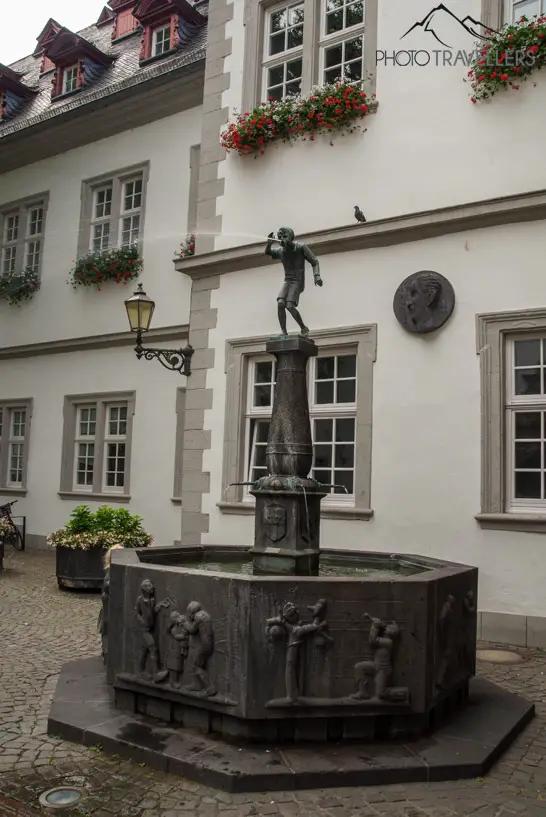 The Schängel in his element
The best travel guides for your trip to Koblenz
With these travel guides in your luggage, you'll be well equipped for your city trip. They give you exclusive insider tips and great sights around Koblenz and the Moselle region.
4th History Column at Görresplatz
The next fountain worth seeing is the 10-metre-high History Column on the beautiful Görresplatz. This impressive monument was donated to the city by the state of Rhineland-Palatinate in 1992 to mark its 2000th anniversary and retells the 2000-year history of Koblenz in ten scenes depicted one above the other.
From Roman times through the age of the Crusades and the Thirty Years' War to the Prussian era and today's Koblenz - the exciting history of the city is vividly portrayed here.
In one of the restaurants around the square you can give your feet a break and let the historical ambience take effect on you.
Address: Josef-Görres-Platz (Google Maps)
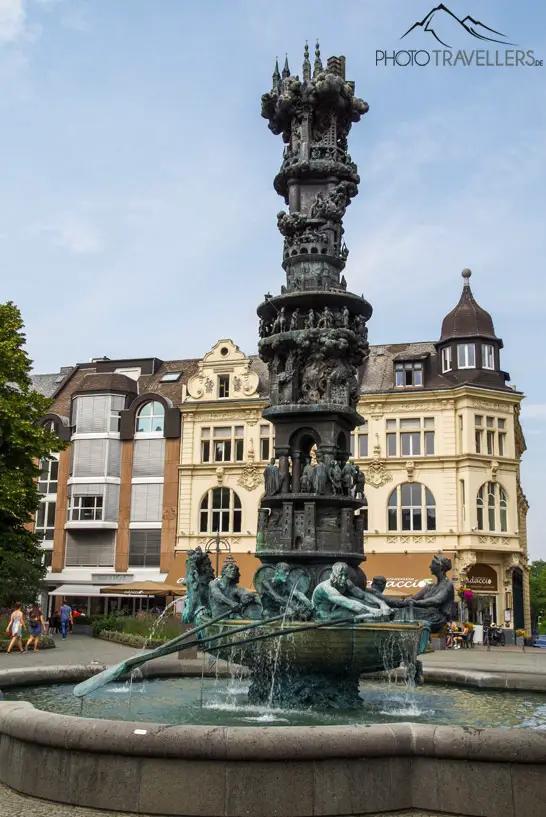 The history column symbolises Koblenz's 2000-year history.
5 German Corner
The Deutsches Eck is probably the city's most famous sight and an absolute must for every visitor to Koblenz. At this special place, two rivers - father Rhine and mother Moselle - flow into each other. As early as 1216, the mouth of the river was given the name "Deutsches Eck" (German Corner) by the Teutonic Order, which had settled there, and today it is a popular meeting place.
Apart from the brilliant view of the two rivers and the fortress opposite, you should also take a look at the Kaiser Wilhelm Monument. The 37-metre-high monument depicts the equestrian statue of Kaiser Wilhelm I, which was commissioned by his grandson - Kaiser Wilhelm II - and ceremoniously inaugurated in 1897.
Since 2002, it has been part of the UNESCO World Heritage Upper Middle Rhine Valley. Nowadays you can make yourself comfortable on the steps in front of the monument and enjoy the imperial panorama.
Address: Konrad-Adenauer-Ufer (Google Maps).
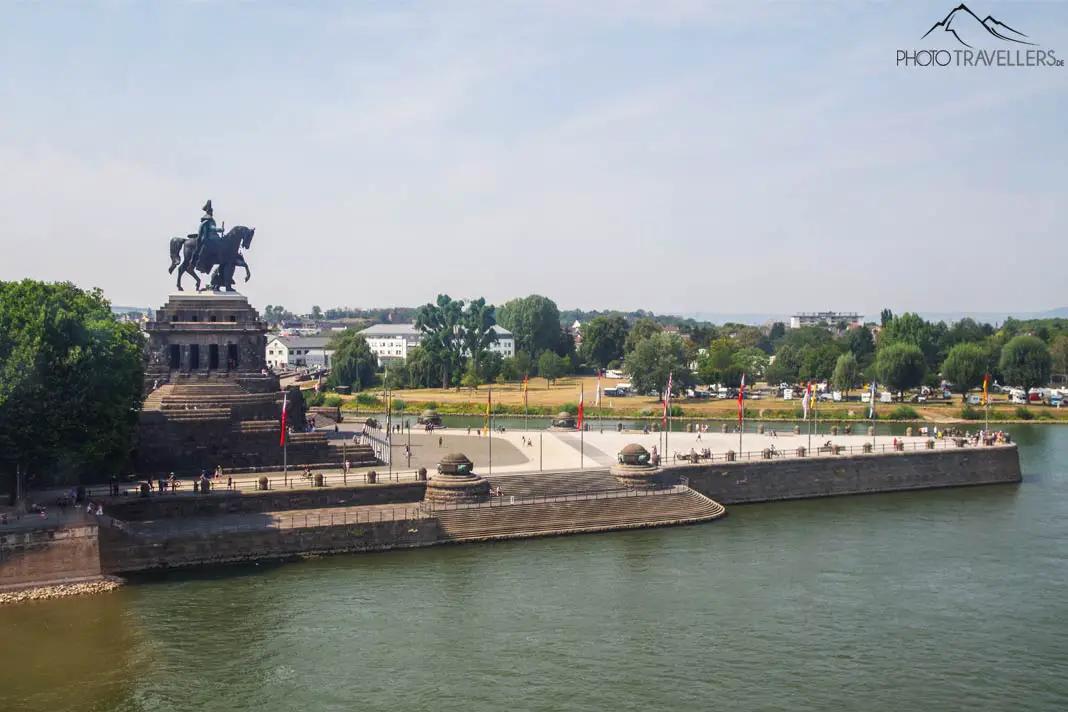 The German Corner with the Kaiser Wilhelm Monument is one of the top sights in Koblenz.
6 Ehrenbreitstein Fortress
Towering 118 metres above the Rhine, Ehrenbreitstein Fortress is the second largest preserved fortress in Europe. From here you have the best view of Koblenz and the confluence of the Rhine and Moselle.
The fortress took on its present form between 1817 and 1828, although the Conradine Ehrenbert had a first castle built on this site as early as around the year 1000 - hence the name "Ehrenbreitstein". Around 1020, the castle came into the possession of the Archbishops of Trier and was repeatedly rebuilt in the following centuries.
The castle was expanded into a fortress for the Electorate of Trier in the 16th century under Archbishop Richard von Greiffenclau. The imposing "Greif" cannon, one of the largest cannons from the 16th century, is still a reminder of this time.
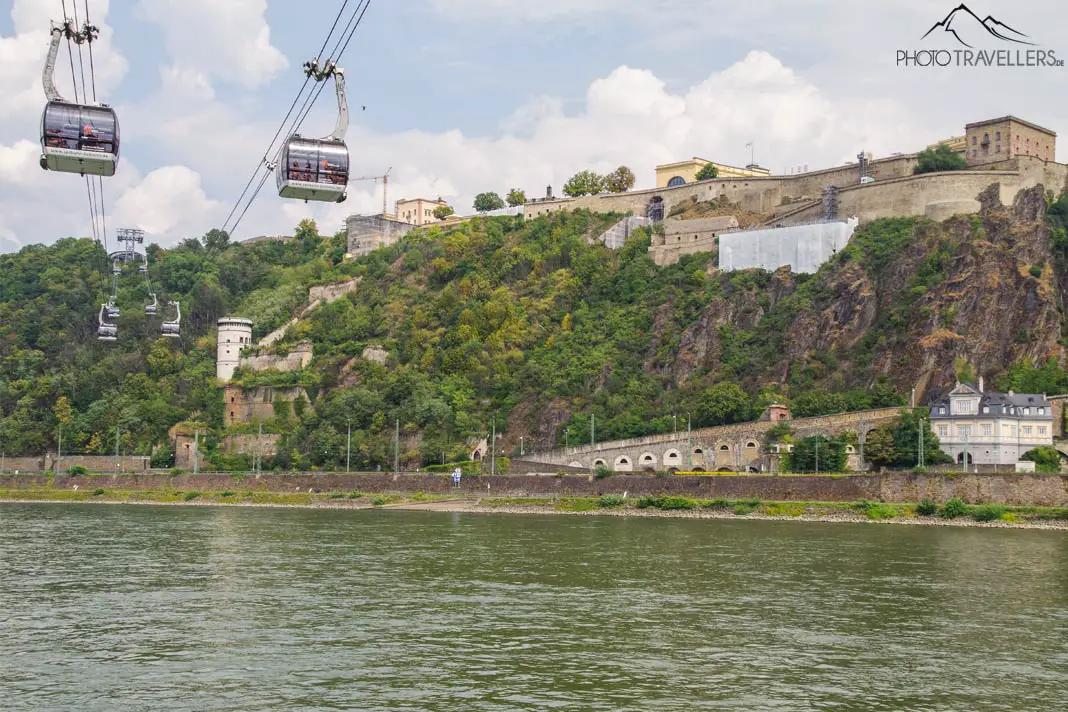 Ehrenbreitstein Fortress is a UNESCO World Heritage Site
The fortress has had a chequered history: during the Thirty Years' War it was temporarily in French possession and was besieged again by French troops during the First Coalition War at the end of the 18th century. In 1801, they blew up the fortress so as not to have to surrender it to the enemy.
After the Congress of Vienna in 1815 made the Electorate of Trier part of the Kingdom of Prussia, King Frederick William III had a new Prussian fortress built with an extensive defence system.
Today you can explore the large fortress grounds. Here you can not only experience the history of the fortress at first hand, but also visit exciting exhibitions in the state museum . What's more, the whole of Koblenz is at your feet.
Tip: You can also enjoy a magnificent panoramic view from the Koblenz cable car, which takes you from Deutsches Eck across the Rhine to Ehrenbreitstein Fortress. It is the most beautiful and comfortable way to reach the fortress.
Address: Ehrenbreitstein Fortress (Google Maps)
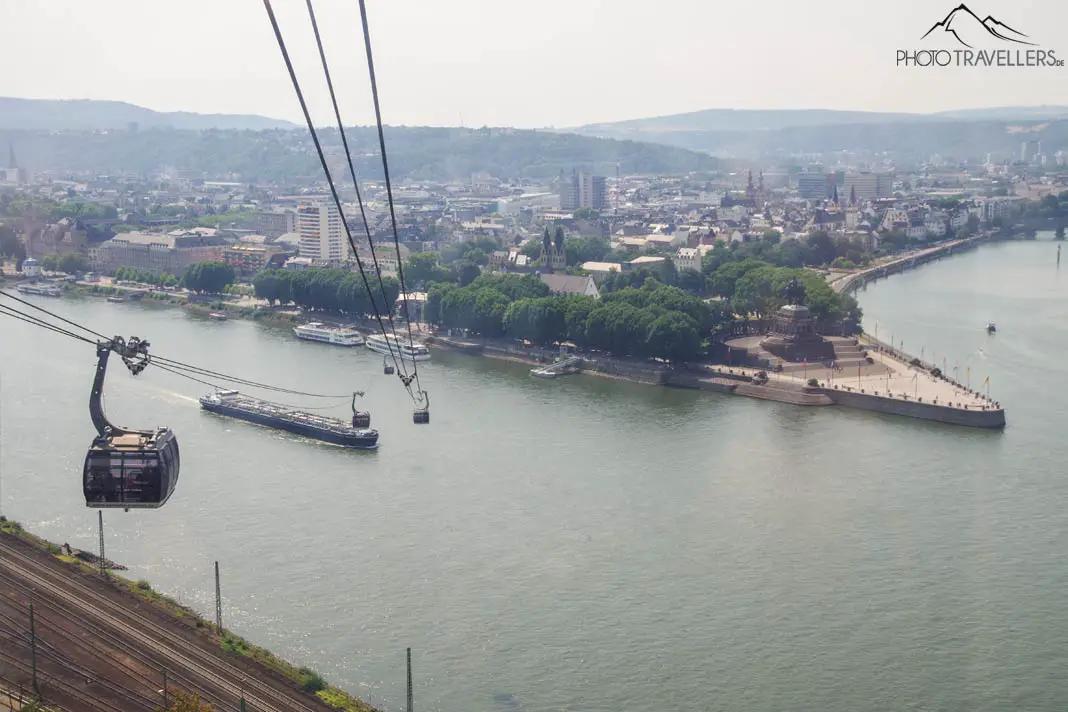 This is the view of Koblenz and the Deutsches Eck from the cable car.
7th Prussian Government Building
Back on the other side of the Rhine, you walk along the riverbank to an imposing monumental building from the 20th century: the Prussian Government Building. It was built between 1902 and 1905 in the Wilhelminian neo-Romanesque style and served as the seat of the Prussian government for the Koblenz administrative district and the main tax office.
Emperor Wilhelm II himself altered the plans of the towers and roofs to echo the imperial power of the Staufer period. The 158-metre-long building around two inner courtyards with side wings still impresses today with its four-storey fa çade on the Rhine side, which looks like a castle to the observer thanks to the corner towers and tuff cladding.
Inside, you can admire the monumental, richly decorated staircase with vaulted halls and elaborate sculptural work. Since 1961, the building has housed the Presidium of the Federal Office of Bundeswehr Equipment, Information Technology and Use.
Address: Konrad-Adenauer-Ufer 12 (Google Maps).
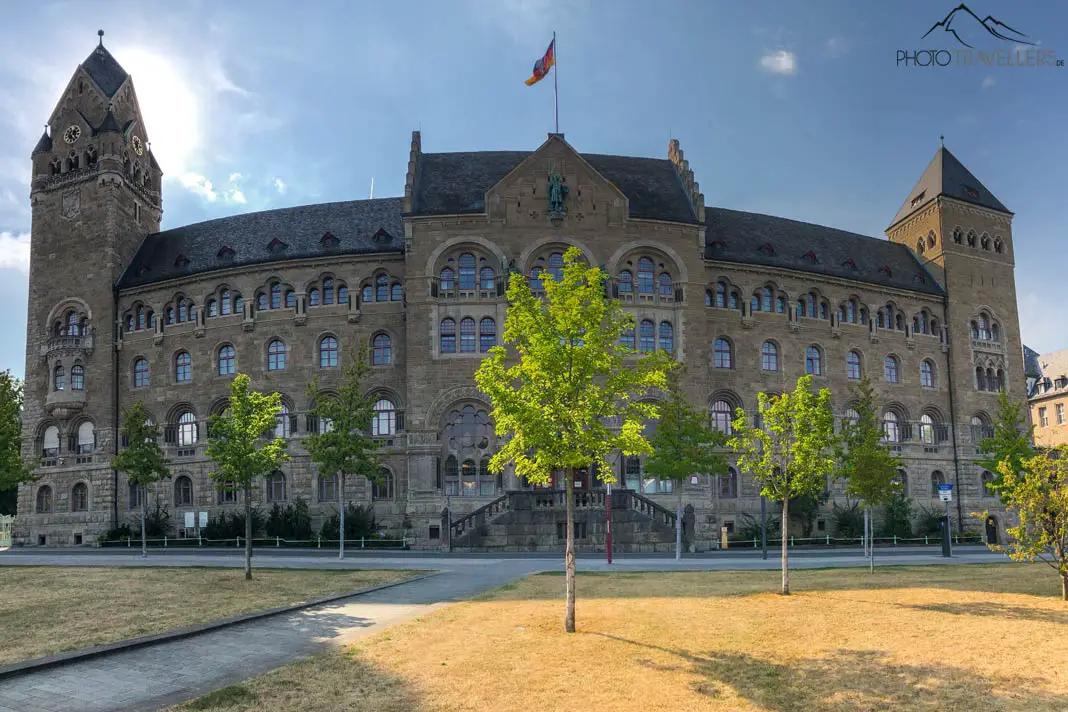 The Prussian government building dominates the path along the banks of the Rhine
8th Electoral Palace
Only a stone's throw away is the Electoral Palace, one of the most important palace buildings of French early classicism in southwest Germany. At the same time, it is one of the last residential palaces built in Germany directly before the French Revolution.
The palace was commissioned by the Archbishop and Elector of Trier, Clemens Wenzeslaus of Saxony, and built between 1777 and 1786. In the mid-19th century, the Prussian Crown Prince and later Emperor Wilhelm I officiated here as military governor. After its destruction in the Second World War, it was rebuilt in 1950/51.
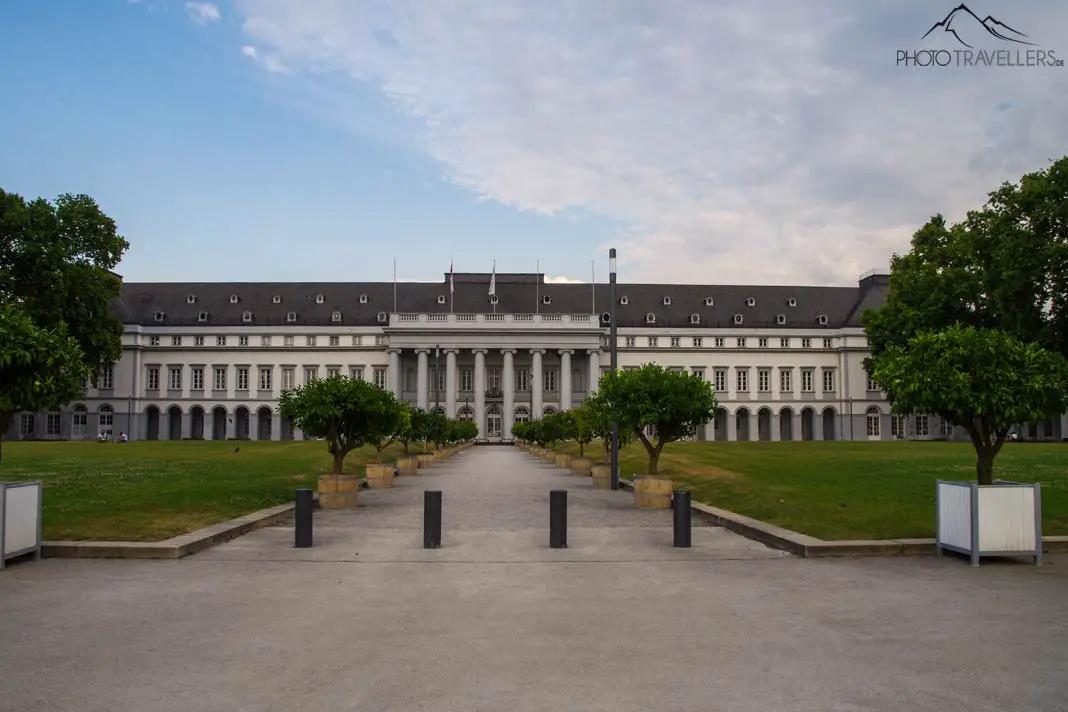 The Electoral Palace impresses with its large park grounds
Nowadays, events such as conferences or family celebrations are held in the palace's interior rooms. On the Rhine side, you can reach the palace steps from the beautifully landscaped palace garden, where you can dangle your feet in the water and enjoy the view of the fortress and river.
Address: Neustadt 24(Google Maps)
9 Stolzenfels Castle
Only a few kilometres south of Koblenz city centre, Stolzenfels Castle is enthroned on the left bank of the Rhine. The neo-Gothic castle was built in the 19th century from the ruins of a 13th century castle and is the symbol of Rhine Romanticism par excellence.
Stolzenfels Castle was built by Archbishop Arnold von Isenburg of Trier and used as a customs post on the Rhine until 1412. In 1689 it was destroyed by the French in the Palatinate War of Succession. In 1802, the ruins became the property of the city of Koblenz, which gave them to Crown Prince Friedrich Wilhelm of Prussia in 1823.
The neo-classical palace was built as a Prussian summer residence from 1836 to 1842 and was ceremoniously inaugurated with a costume ball in 1842. To this day, you can still experience the Prussian romanticism of the Rhine in the palace grounds.
Particularly worth seeing are the beautiful pergola garden, the landscape park with its waterfalls and grottos, and the Rhine terrace, from which you have a magnificent view all the way to Koblenz.
Tip: On a tour of castles and palaces , you can take a boat past the most important sights around Koblenz and admire Stolzenfels Castle from the water.
Address: Schlossweg 11(Google Maps)
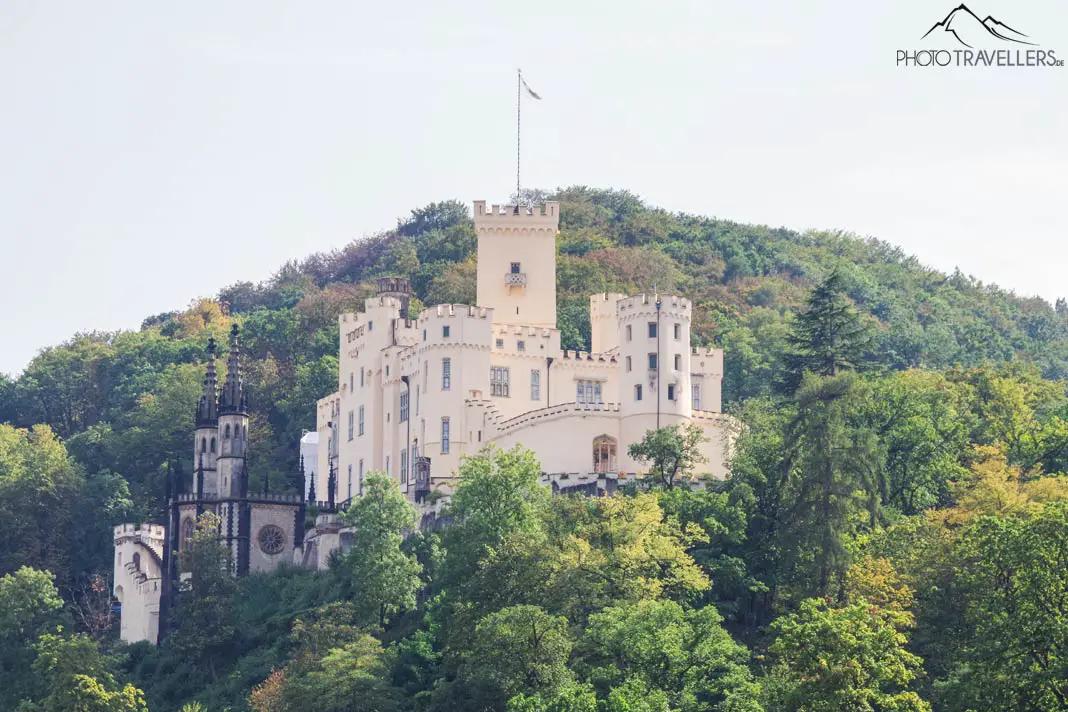 During a boat trip you can admire Stolzenfels Castle in all its glory.
Insider Tip Winery Göhlen
The Rhine-Moselle region is known for its many beautiful vineyards where excellent wine is grown. At the foot of Ehrenbreitstein Fortress, surrounded by vineyards, lies the Göhlen W inery, which I can only recommend you visit.
The family business has been growing wine in the Middle Rhine region since 1921 and impresses with its wide range of white and red grape varieties. During a cellar tour, you can experience the romantic ambience of the traditional oak barrels, but also get to know the modern tank storage.
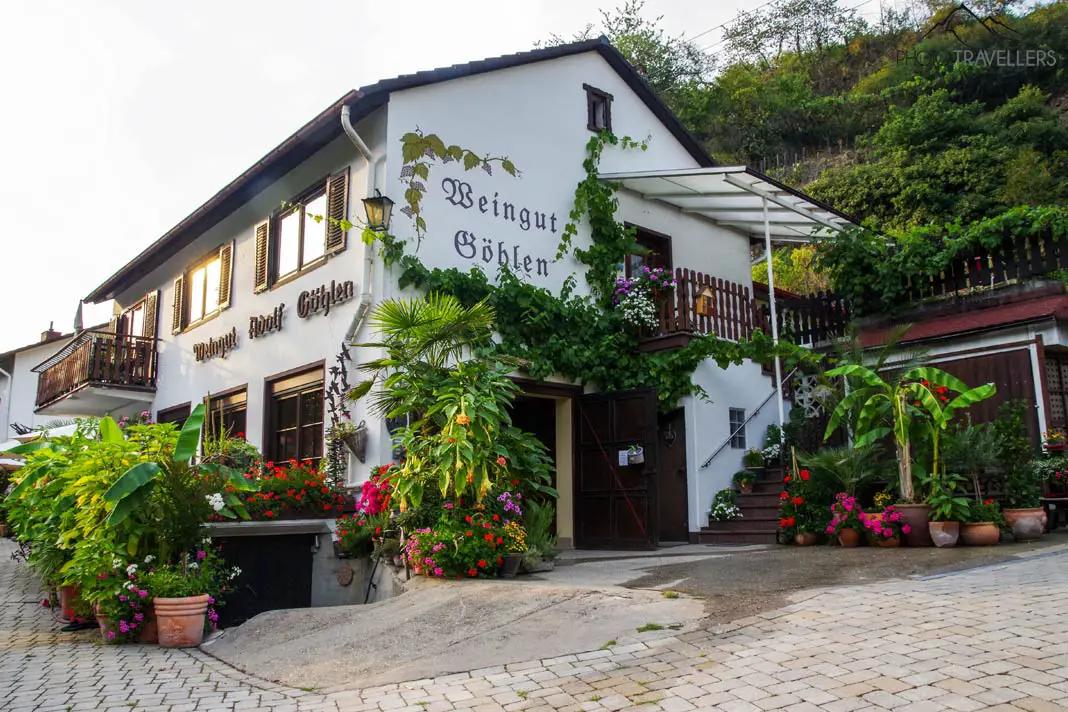 Wine has been grown at the picturesque Göhlen vineyard for three generations.
Afterwards, you can enjoy a wine tasting of five different wines, which are served on the beautiful terrace in summer. Surrounded by vines and palm trees, you'll feel like you're on the Mediterranean and learn a thing or two about winemaking: What you can uncork today, don't put off until tomorrow.
An ultimate taste experience in an idyllic location: the Göhlen Winery will also remain in your memory. Don't worry: you can take a bottle or two of vintner's art with you and thus secure the pleasure of uncorking for home as well.
Address: Mühlental 33 (Google Maps)
Excursion tip in the area: Eltz Castle
Once upon a time, hidden in the forest, there was an enchanting castle like no other: If you're into fairytales, Eltz Castle is the right place for you. The famous fairytale castle is considered the epitome of a knight's castle and is one of the most beautiful sights in all of Germany.
No wonder: its picturesque location on a 70-metre-high rock in the midst of beautiful nature and its unique architecture make it a dream destination in the Moselle region.
The "castle par excellence" looks back on a history of more than 850 years: in 1157, the name Eltz was first mentioned in a document, although the Eltz family and thus also the castle were divided before 1268.
From then on, the three family lines lived together at Eltz Castle as a so-called Ganerbengemeinschaft . It was one of the few castles in the Rhineland to be saved from destruction in wars and is still owned by the family today.
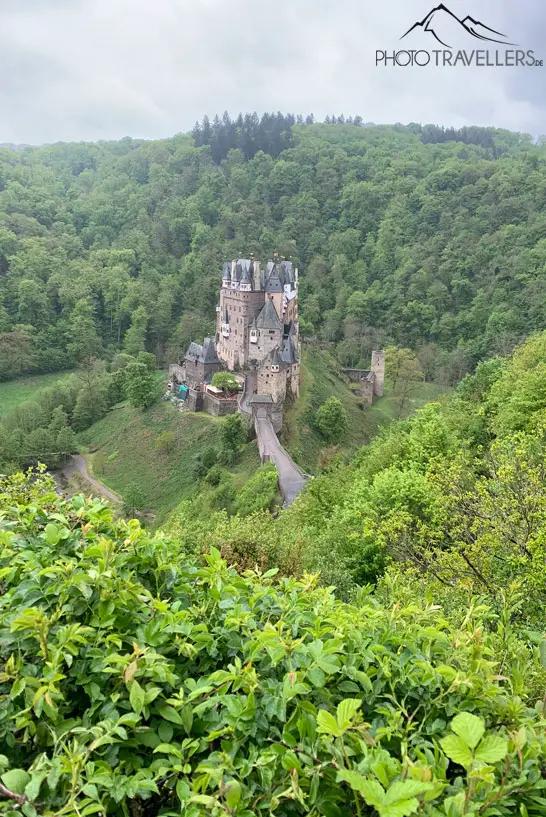 Eltz Castle is a must-see on any trip to Germany
On a guided tour of the castle, you can visit the interior rooms and experience life in the Middle Ages and early modern times. You can also learn more about the castle's impressive 500-year history of construction.
Another highlight is the armoury and treasure chamber, which is one of the most valuable in Europe and houses precious gold and silversmith's work, jewellery, porcelain and weapons from eight centuries.
Tip: For a special wow moment, be sure to come before the castle's opening hours to enjoy the fairytale view of nature and architecture in peace and quiet. The Eltzer Burgpanorama dream path also offers further beautiful views from the Moselle plateau.
Address: Eltz Castle, 56294 Wierschem(Google Maps).
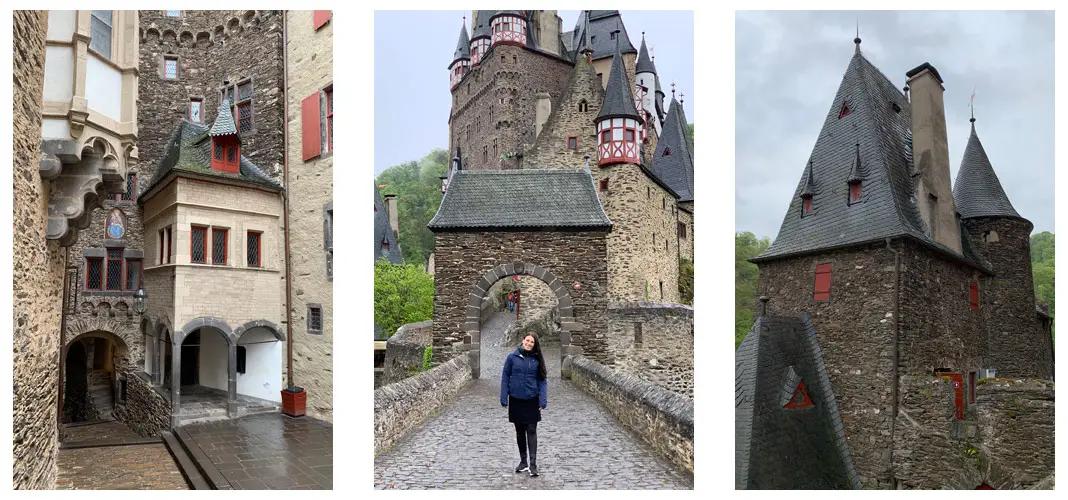 There really is a lot to discover at Burg Eltz
Eating & Drinking in Koblenz
As you have already seen, Koblenz has a lot to offer in terms of wine. Here I'll show you the restaurants where you can enjoy a glass or two of wine and/or further your culinary education:
In the Winninger Weinstuben you can look forward to regional wines and matching dishes in a cosy atmosphere. Specialities of the house are the Rieslinghäxle and tarte flambée. Address: Rheinzollstraße 2 (Google Maps): Rheinzollstraße 2 (Google Maps)
The historic Weinhaus Hubertus delights with its large selection of regional wines and Rhenish specialities. The quaint 17th-century half-timbered house is reminiscent of Alsatian architecture and enchants with a very special atmosphere that you should see for yourself. Address: Florinsmarkt 6 (Google Maps)
In the heart of Koblenz's old town you will also find the cosy SauBar. Here, saucy dishes of German cuisine are on the menu. Address: Münzstraße 16A (Google Maps)
Get a little piece of Italy at Ristorante La Gondola. Among other specialities, the fish dishes and homemade pasta are particularly recommended. Address: Rheinstraße 4-6 (Google Maps)
Fans of Asian cuisine are in good hands at Papa Umi. In this modern location you can enjoy noodle, curry and sushi dishes, among others. Address: Löhrstraße 109 (Google Maps)
Whether breakfast, lunch or coffee & cake: A detour to Café Bistro Pfefferminzje is always a good idea. Here you can enjoy many vegetarian and vegan delicacies on the picturesque terrace in the Brunnenhof. Why not also try the in-house coffee blend "Pfefferminzje". Address: Mehlgasse 12 (Google Maps)
Where to stay in Koblenz - the best hotel tips
A nice low-budget option is the Hotel Jan van Werth, which offers cosy rooms in a family atmosphere. Directly at the main railway station, but still in a quiet location, is the Hotel Hohenstaufen, which impresses with modern rooms and its in-house restaurant.
In the heart of the old town, the modern Sander Hotel enchants with its location and its delicious breakfast buffet with regional products. Nearby is also the family-run Trierer Hof, which harmoniously combines tradition and modernity.
If you want to take a look at the Rhine and Ehrenbreitstein Fortress right after waking up, the Hotel Haus Morjan is the right address. Apart from the unbeatable view, it scores with its cosy sun terrace and tastefully furnished rooms.
A great alternative to the hotel are also the flats in the holiday flat Koblenz Altstadt, which impress with their beautiful furnishings and central location.
Facts & figures about Koblenz
Koblenz is one of the oldest towns in Germany - a Roman fort was built here as early as 9 BC.
At that time, the settlement was called "confluentes" - meaning the confluence of the Rhine and Moselle rivers.
Today, Koblenz has a population of around 114,000, making it the third-largest city in Rhineland-Palatinate.
In the regional dialect, the city is also called "Kowelenz".
Parts of the city are part of the UNESCO World Heritage Site Upper Middle Rhine Valley
Excellent wine has been grown in the Rhine-Moselle region since early Roman times